AI architecture
CAG vs. RAG: best practices for professional analysis
Jan 14, 2026
Executive summary
For financial professionals, the distinction between context augmented generation (CAG) and retrieval augmented generation (RAG) is not merely technical trivia. It determines whether an AI agent can successfully detect a subtle contradiction in a loan agreement or accurately cite a firm-wide independence policy. Using the wrong architecture for a specific assurance task is the most common cause of hallucinations and superficial outputs.
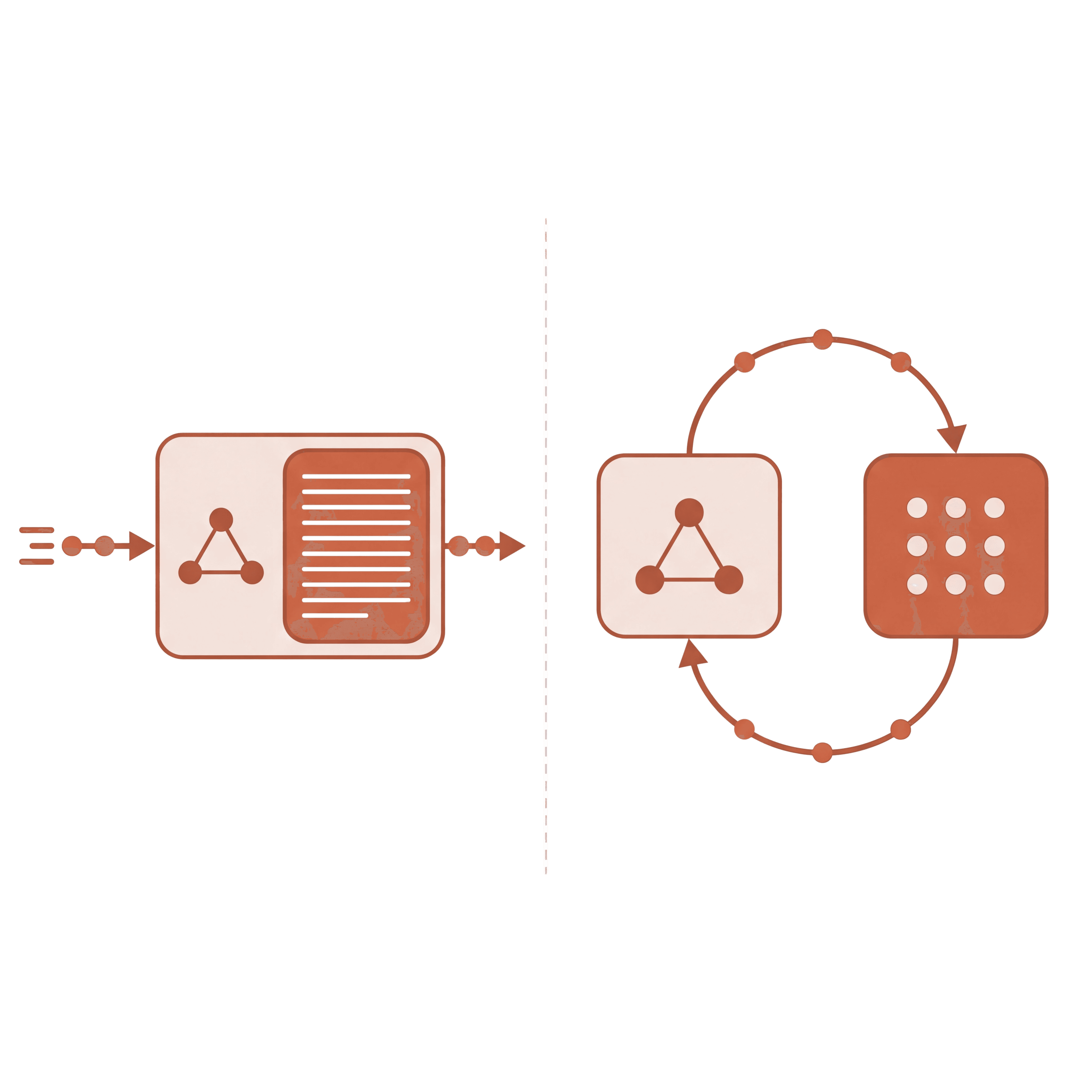
CAG is best suited for deep, complex reasoning within a finite set of documents (the 'deep dive'), while RAG is designed for locating specific facts across a vast knowledge base (the 'broad search').
The following table summarises when to apply each architecture to professional workflows.
Architecture | The metaphor | Optimal use case | Technical mechanism |
|---|---|---|---|
CAG (context augmented Generation) | The analyst: Clears their desk to study one specific file intensely. | Deep analysis: Checking a single Annual Report for internal consistency or reviewing a syndicated loan agreement for cross-references. | Context caching: Loads the entire document set into the AI's active memory (context window) for holistic processing. |
RAG (retrieval augmented generation) | The librarian: Searches a massive archive to find a specific page. | Broad research: Querying a database of 5,000 tax rulings or checking compliance against a firm-wide independence manual. | Semantic search: Uses a vector database to find relevant snippets, often connected via MCP to securely access internal systems. |
1. Introduction
In the first phase of AI adoption, many firms simply treated the technology as a smarter search engine. Professionals would paste a question into a chat window and hope for a correct answer. However, as firms move towards integrating AI into complex workflows, such as reviewing a 300-page annual report or cross-referencing global tax treaties, the limitation of this simple approach becomes clear. The quality of the AI's output is strictly limited by the context it can access.
To build reliable professional agents, we must understand the two primary architectures for providing this context: context augmented generation (CAG) and retrieval augmented generation (RAG).
While these acronyms sound technical, they represent two very different ways of working that every auditor and tax advisor already recognises. CAG is the equivalent of a 'deep dive', where an analyst studies a single set of documents intensely until they know them by heart. RAG, conversely, is the equivalent of a 'broad research' task, where a professional searches a vast library to find a specific precedent.
Choosing the wrong architecture for the wrong task is the most common reason for AI failure in professional services. A RAG approach applied to a specific contract review can miss critical connections, while a CAG approach applied to a global regulatory search will fail due to data overload. This article outlines how to distinguish between the two and how to deploy them effectively in your practice.
2. CAG: the deep dive (the 'active memory' approach)
Context augmented generation, or CAG, is the architectural equivalent of clearing your desk to focus entirely on one specific client file. In this method, the relevant documents, such as a specific annual report, a loan agreement, or a set of meeting minutes, are loaded directly into the AI’s 'context window'. This allows the AI to 'see' the entire document set simultaneously while answering your questions.
Understanding context caching
A significant advancement in this field is the concept of 'context caching' or 'prompt caching'. Historically, every time you asked an AI a follow-up question, the model had to re-read the entire document from scratch to generate an answer. This was slow and computationally expensive.
Modern caching techniques allow the AI to 'study' the document once and store the processed information in a temporary, high-speed memory layer. Imagine you have a new Junior Associate and you hand them your firm’s 200-page Audit Methodology. Instead of asking them to read the entire manual again every time you ask a question about sampling sizes, they read it once, memorise the structure, and can instantly recall the relevant section for the duration of your project.
In technical terms, the system pre-loads the static data (like the client's permanent file or the relevant tax code) into the context cache before the conversation begins. This ensures that the AI answers every subsequent question with full awareness of the complete dataset, without the latency of re-processing the text.
When to use CAG
CAG is the superior choice for deep, analytical tasks where the relationships between data points matter.
Contradiction detection: If you need to check if the 'sustainability risks' described in the director's report align with the 'impairment assumptions' in the Financial Statements, CAG is essential. The AI needs to hold both sections in its active memory to compare them.
Complex agreements: For reviewing a syndicated loan agreement, the AI must remember the definitions on page 5 to correctly interpret the covenants on page 80.
The verdict: Use CAG when your scope is finite (e.g., "This specific audit file") but your need for reasoning is deep.
3. RAG: the broad research (the 'librarian' approach)
While CAG is powerful for deep analysis of specific files, it is impossible to load every global accounting standard, every historical tax ruling, and every internal firm policy into a single context window. This is where retrieval augmented generation (RAG) becomes necessary.
If CAG is the analyst studying one file at their desk, RAG is the librarian standing in a vast archive. The librarian does not memorise every book. Instead, they use a sophisticated index to locate the exact page containing the answer you need.
How semantic search works
RAG relies on a technology called 'vector databases' which allows for semantic search. Unlike a traditional keyword search (Control-F) that looks for exact text matches, semantic search understands the meaning of your query.
For example, if a tax advisor asks about "business lunch deductibility", a standard keyword search might fail if the policy uses the word "hospitality". A RAG system, however, understands that "lunch" and "hospitality" are conceptually related in a tax context. It retrieves the relevant paragraphs from your firm’s policy database or the specific articles of the tax code and presents only those snippets to the AI to generate an answer.
Connecting the data: the role of MCP
While RAG describes how the AI searches for information, we still need a way to connect the AI to the actual databases, whether that is a secure SharePoint, an SQL database, or a legal repository.
Historically, connecting these data sources required complex, custom integration scripts that were difficult to maintain. Today, the model context protocol (MCP) acts as the standard infrastructure for these connections. You can think of an MCP server as the universal connector that links the 'librarian' (the AI) to your private 'archive' (your internal data).
By using MCP servers to facilitate RAG, firms avoid the security risks of uploading data to public clouds. Instead, the MCP server provides a controlled tunnel, allowing the AI to query your local data structures securely. It retrieves the specific clause regarding 'gift acceptance policy' or 'remote work allowances' and grounds the AI's response in your firm’s official documentation.
When to use RAG
RAG is the standard architecture for knowledge management and broad compliance checks.
Policy consultation: "What is the firm's independence policy regarding holding shares in a client?" (Searching across hundreds of internal PDFs).
Technical research: "Find all precedents in the last five years regarding the tax treatment of crypto assets." (Searching a vast external legal database).
The verdict: Use RAG when your scope is broad (e.g., "The entire library") and you need to find specific facts quickly.
4. Conclusion
As AI tools transition from novelty to necessity within the audit and tax professions, the ability to distinguish between CAG and RAG will become a defining skill for technical leadership. There is no single 'best' architecture; the choice depends entirely on the nature of the assurance task at hand.
Attempting to force a RAG architecture to perform a deep contradiction analysis of a single annual report will often result in superficial answers that miss the nuance of the text. Conversely, attempting to use CAG to memorise an entire library of tax case law is computationally impossible.
For the modern professional, the key takeaway is intentionality. When you are performing a deep review of a client file, ensure your tools are using context caching to load the specific documents into active memory. When you are researching a technical standard or an internal policy, ensure your system utilises a semantic search, ideally connected via a standard like MCP to ensure security and reliability.
By understanding these architectural foundations, firms can move beyond the frustration of generic chatbots. We can instead build reliable, engineered workflows where the AI acts as a grounded analyst for specific files and a knowledgeable librarian for broader research, ultimately delivering the accuracy required for professional sign-offs.